

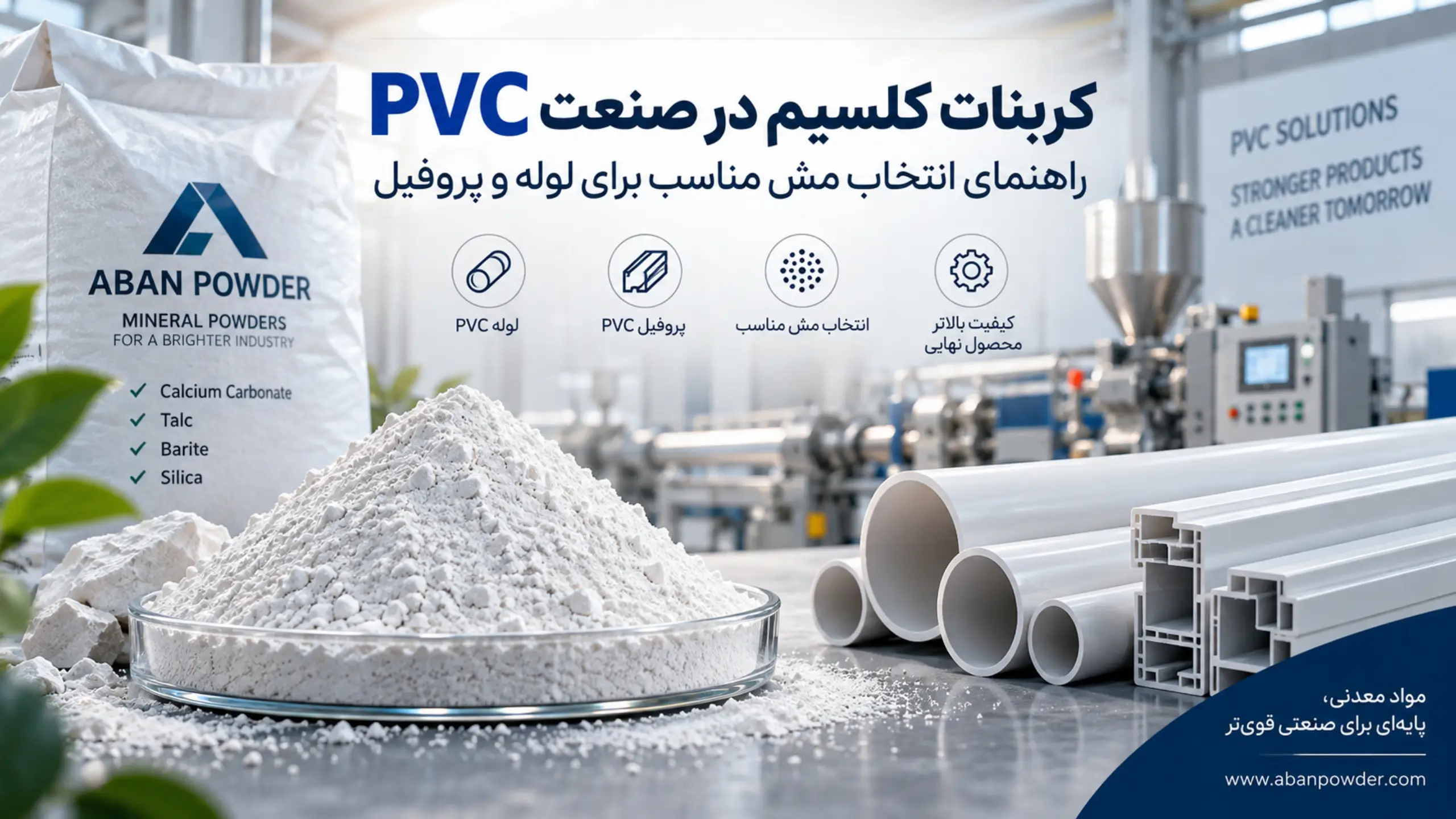
Calcium Carbonate in the PVC Industry: A Guide to Choosing the Right Mesh for Pipes and Profiles
Calcium carbonate is one of the most widely used minerals in the PVC industry, but choosing it is not simply a matter of buying a reasonably priced white powder. Particle size, uniformity of particle size grading, purity, moisture content and the surface properties of the powder can all affect how the material behaves on the production line and the quality of the final product.
For this reason, manufacturers of pipes, profiles, sheets or other PVC products should know before buying which calcium carbonate specifications matter most for their production line.
In this guide, we examine the role that calcium carbonate in the PVC industry plays, how the right mesh is selected, and which specifications should be checked when purchasing this raw material.
Why Is Calcium Carbonate Used in the PVC Industry?
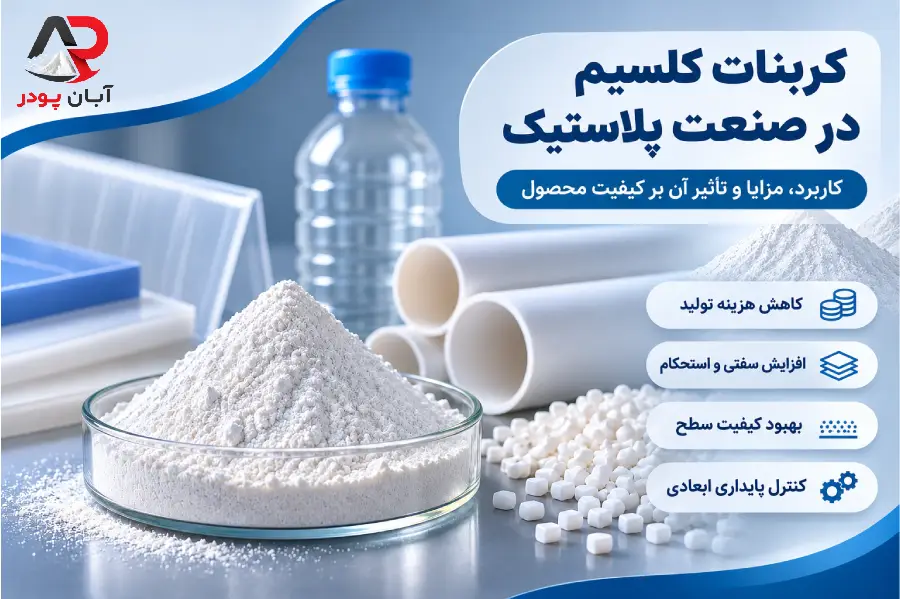
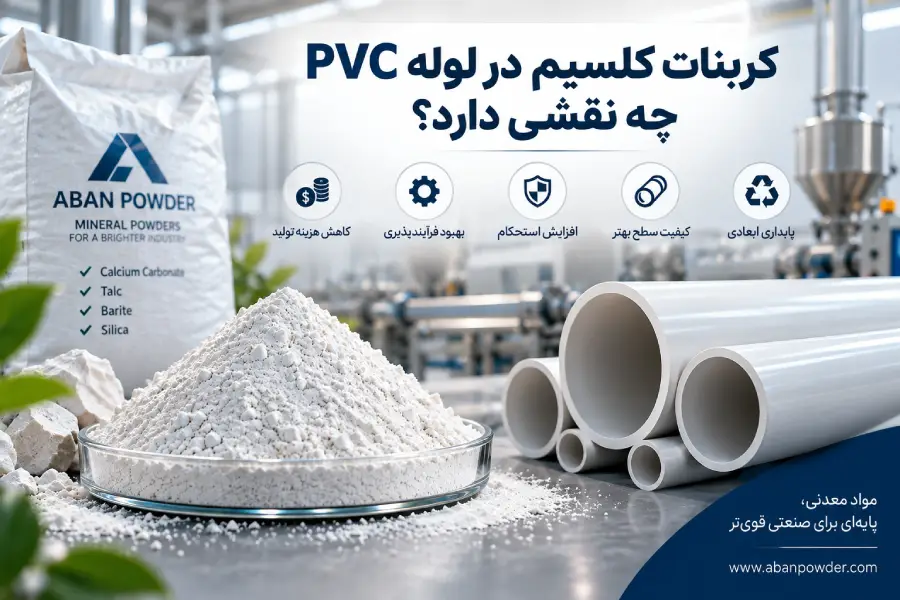
Calcium carbonate is used as a mineral filler in many PVC formulations. However, its role is not limited to increasing the volume of the compound or reducing the share of more expensive materials.
Choosing the right grade can affect the stiffness, dimensional stability, processability and appearance of the product. Conversely, using an unsuitable powder or uncontrolled particle size grading may lead to problems such as a poor surface finish, weak dispersion or a decline in certain mechanical properties. Specialized industry sources also emphasize that the results of using calcium carbonate depend on the type of PVC, the particle size and its distribution, the surface coating and the dosage.
Therefore, the question “What is the best calcium carbonate for PVC?” has no single answer without knowing the type of final product.
What Role Does Calcium Carbonate Play in PVC Pipes?
In pipe production, the specifications of the final product are very important. Pressure pipes and non-pressure pipes do not have the same requirements, and a single fixed formula cannot be recommended for both.
For example, in pipes that must withstand internal pressure, the mechanical properties and durability of the product are of great importance. In non-pressure products, factors such as stiffness, impact resistance, weight and surface quality are also taken into account.
For this reason, manufacturers should determine the amount and grade of calcium carbonate based on the formulation, the line equipment and the standard of the final product.
Increasing the filler content solely to reduce costs, without running production line trials, can backfire.
Applications of Calcium Carbonate in PVC Profiles
PVC profiles, especially products whose surfaces are visible, are sensitive to the uniformity of raw materials.
In these products, in addition to mechanical properties, factors such as surface smoothness, color, uniformity and dimensional stability are important.
Coarse particles or particle agglomerates can affect the surface appearance. That is why the mesh number alone is not enough, and the actual quality of the particle size grading must also be taken into account.
Calcium carbonate in the PVC industry delivers better results when the powder specifications remain consistent from one shipment to the next.
What Does Calcium Carbonate Mesh Mean for PVC?
Mesh is one of the terms buyers frequently encounter when purchasing mineral powders, and it is generally used to express the fineness of the particles.
However, a common mistake is for the buyer to treat the mesh number as the sole measure of quality.
Two powder samples sold under the same commercial mesh do not necessarily have exactly the same particle size distribution. In a more precise technical assessment, parameters such as particle size distribution and indicators like D50 and D97 or D98 can provide more information about the particles.
So when choosing calcium carbonate for PVC, rather than simply asking “What mesh is it?”, it is better to review the product’s complete technical specifications.
If you would like to learn more about the effect of particle size on the performance of mineral powders, be sure to read the article “The Effect of Mesh and Particle Size Grading of Mineral Powders on the Quality of Industrial Products” as well.
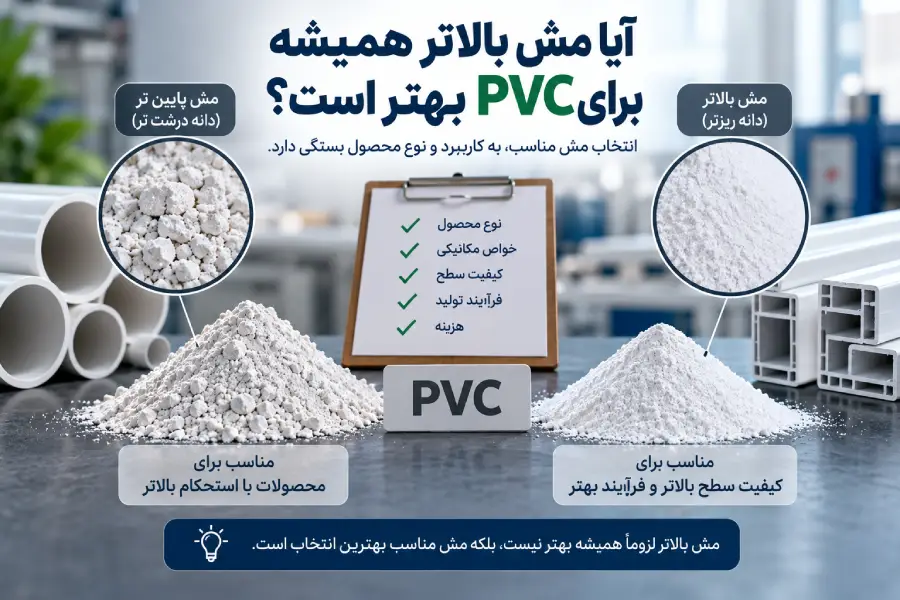
Is a Higher Mesh Always Better for PVC?
No.
A finer powder is not, by itself, more suitable for every application. The type of product, the formulation, the mixing method, the extrusion equipment and the properties expected of the final product all influence the choice of particle size grading.
Manufacturers sometimes assume that the higher the mesh number, the higher the quality of the final product will necessarily be. This view can lead to choosing a grade that is not economically or technically suitable for the production line.
The goal should be to find the particle size grading that suits the application rather than to pick the highest number available.
Aban Powder produces micronized powders up to 3500 mesh; therefore, it is better to choose a grade based on the actual needs of the line, not merely on the maximum fineness that can be produced.
Why Does Calcium Carbonate Purity Matter in PVC?
Purity is another important specification of mineral raw materials.
The presence of various compounds and impurities in the raw rock can change the specifications of the final powder. That is why consistent raw material quality becomes very important in industrial supply.
According to information published on the Aban Powder website, the company’s products are checked for purity, whiteness, moisture and particle size grading before being supplied.
For a plant in continuous production, the consistency of these specifications across different shipments can be as important as the quality of an initial sample.
What Effect Does Calcium Carbonate Whiteness Have?
In products where color and surface appearance matter, the whiteness of the mineral is one of the parameters worth evaluating.
This becomes even more important in white profiles, some pipes and products whose final color must be controlled.
Of course, high whiteness alone does not mean that a calcium carbonate is suitable for PVC. A powder may look very white yet have a particle size grading or other specifications that are not compatible with the intended formulation.
Therefore, whiteness should be evaluated alongside other technical indicators.
Don’t Overlook Powder Moisture
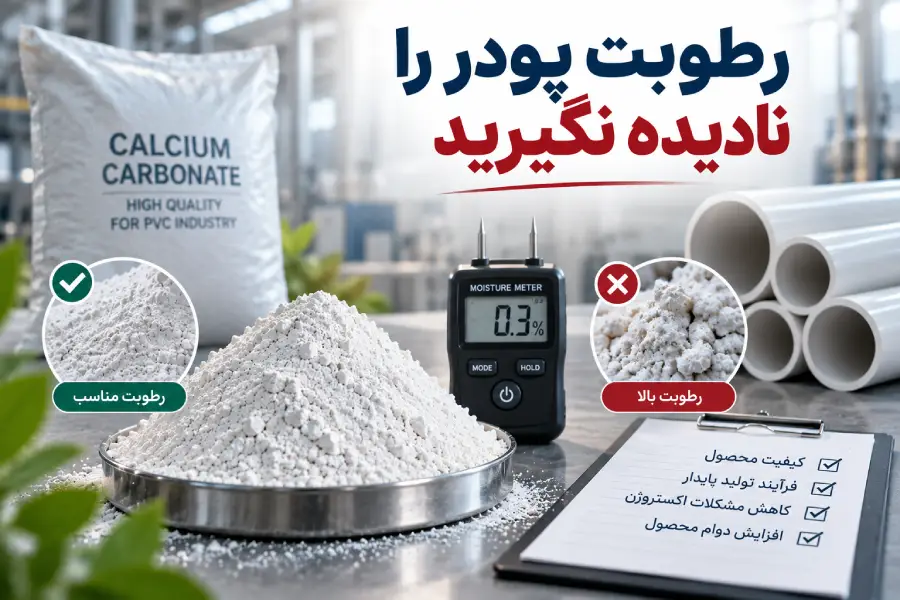
Moisture is one of the specifications that sometimes receives less attention when buying calcium carbonate.
On an industrial production line, variations in raw materials can affect process behavior. For this reason, it is best to check moisture as a quality control parameter alongside purity and particle size grading.
Especially with continuous supply, the goal is not just to receive one suitable shipment; consistent quality in subsequent orders matters even more.
Uncoated or Coated Calcium Carbonate for PVC?
One of the key questions buyers ask is whether uncoated or coated calcium carbonate is better.
The answer depends on the system and the formulation.
In coated calcium carbonate, the particle surface is modified to change how the particles behave in polymer media. In some polymer applications, coated grades can offer advantages in terms of dispersion and compatibility with the polymer matrix. Industry sources also report the use of coated calcium carbonate in rigid and flexible PVC, profiles, pipes and cable sheathing.
However, without testing and reviewing the formulation, it cannot be said that the coated type is the better choice on every line.
For more technical information on the use of calcium carbonate in polymers and PVC, you can also consult the specialized resources of Omya, an international producer of industrial minerals.
How Do You Choose the Right Calcium Carbonate for a PVC Production Line?
To make a better choice, first define the final product. The needs of a window profile plant are not the same as those of a sewer pipe or cable sheathing manufacturer.
Next, review the technical specifications of the powder. Particle size grading, purity, whiteness, moisture and, where needed, the type of surface coating are among the factors worth checking.
The next step is testing a sample on the actual line.
How a powder performs under real production conditions gives the manufacturer far more information than choosing solely on the basis of price or mesh number.
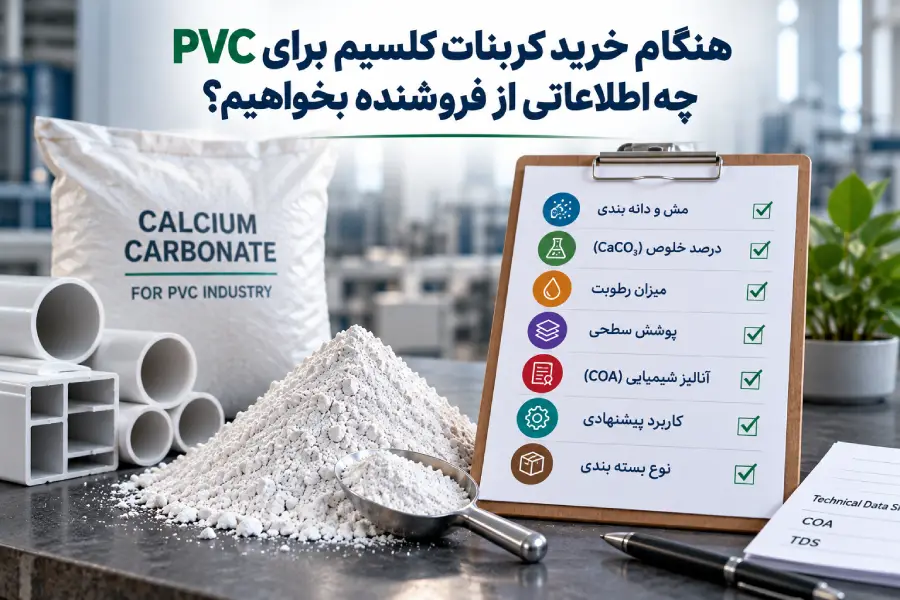
What Information Should You Request from the Supplier When Buying Calcium Carbonate for PVC?
Before placing a bulk order, it is best to obtain the product’s technical specifications and ask about the consistency of production quality.
Key information includes the following:
- Type of calcium carbonate
- Particle size grading and mesh
- Purity
- Whiteness
- Moisture content
- Type of surface coating, if any
- Consistency of specifications in bulk orders
- Packaging type
- Capacity for continuous supply
For a plant that consumes significant volumes of material every day, the ability to supply on a regular basis is also part of purchase quality.
Is the Cheapest Calcium Carbonate the Right Choice?
The price of raw materials is important, but comparing two products solely on price per kilogram can be misleading.
Suppose a cheaper powder causes more scrap, process fluctuations or a drop in surface quality. In such a case, the initial savings may create higher costs on the production side.
On the other hand, buying a very expensive grade that exceeds the line’s technical needs is not necessarily sensible either.
The best choice is a product that strikes the right balance between price, quality and performance on the production line.
Why Is Consistent Particle Size Grading Important in Bulk Orders?
Plants rarely use raw materials just once. Purchases are repeated over different periods, and this is what makes consistent quality so important.
If the particle size grading or other raw material specifications vary significantly from one shipment to the next, the line settings may also need to be adjusted.
Conversely, a supply of product with stable specifications helps the manufacturer run a more predictable process.
In its company profile, Aban Powder highlights its production of micronized powders in a variety of particle size gradings, its quality control and its ability to fulfill bulk orders.
Common Mistakes When Choosing Calcium Carbonate for PVC
One common mistake is choosing a product based on mesh alone. Calcium carbonate in the PVC industry should be selected based on a set of specifications.
The second mistake is increasing the dosage solely to reduce formulation costs. The appropriate filler level depends on the type of product and its technical requirements.
Buying in bulk without sample testing is also highly risky. Before changing supplier or grade, it is best to trial the product on the line at a controlled scale.
Finally, the consistency of quality in subsequent shipments should not be overlooked.
Conclusion
Calcium carbonate in the PVC industry is an important raw material, but its performance depends on choosing the right grade. Particle size grading, purity, whiteness, moisture, surface properties and quality consistency should be evaluated according to the product type and production line conditions.
For pipes, profiles and other PVC products, no single mesh can be recommended as the best option for every plant. It is better to first define the product’s technical needs, then select several suitable grades and test samples of them under real line conditions.
Aban Powder produces calcium carbonate and other mineral powders in Aligudarz, and according to the company’s website, it can produce micronized powder up to 3500 mesh and fulfill bulk orders for industry.